Brussels is a small capital with a big personality. In a single day you can stand in one of the most beautiful squares in Europe, eat fries from a stand that has been frying since 1948, walk past Art Nouveau houses listed by UNESCO and look out over the city from the top of the Atomium. It is also the seat of the European Union, a bilingual city (French and Dutch) and, for many travellers, the perfect base for day trips to Bruges, Ghent and Antwerp.
This guide brings together everything you need to plan your visit: the essential sights, the neighbourhoods worth exploring, what to eat, how to get around, and simple itineraries for one, two or three days. Each section links to a more detailed guide if you want to go deeper.
Brussels at a glance
- Languages: French and Dutch are both official. English is widely spoken in hotels, restaurants and museums.
- Currency: euro. Cards and contactless payment are accepted almost everywhere.
- Getting there: Brussels Airport is about 20 km from the centre, around 20 minutes by train. Eurostar trains reach Brussels-Midi in about 2 hours from London and from about 1 hour 22 minutes from Paris.
- How long to stay: two days to see the highlights, three days to add museums and neighbourhoods, longer if you plan day trips.
- Tap water: safe to drink.
Grand-Place and the historic centre
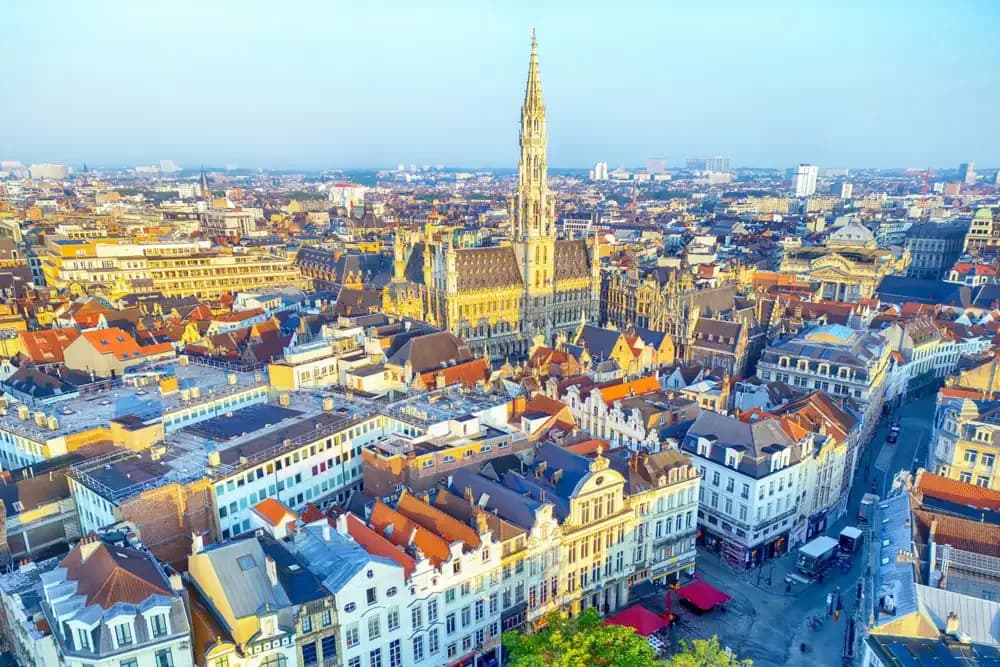
Every visit starts at the Grand-Place (Grote Markt), the central square listed as a UNESCO World Heritage Site since 1998. It is framed by the Gothic Town Hall, built in the 15th century, with a spire that rises to about 96 metres, and by the richly decorated guildhouses of the old trade corporations. Opposite the Town Hall, the King's House (Maison du Roi) holds the Brussels City Museum.
Try to see the square twice: once in daylight to appreciate the gilded façades, and once after dark when it is lit up. In mid-August of even years, the square hosts the famous Flower Carpet; the 2026 edition has taken place, so the next one is expected in 2028.
Tips for the Grand-Place
- Early morning is the quietest time for photos.
- The streets around the square, such as the Rue des Bouchers, are lined with restaurants aimed at tourists. Compare menus before you sit down.
- The cobblestones are uneven: wear comfortable shoes.
Manneken Pis and the old streets
A five-minute walk from the Grand-Place, Manneken Pis is the city's most famous (and smallest) celebrity. The bronze statue was commissioned in 1619 from the sculptor Jérôme Duquesnoy the Elder. The figure on the street corner today is a replica from 1965; the original is kept in the Brussels City Museum on the Grand-Place.
The statue is regularly dressed in costumes, and around 1,000 of them are displayed at the GardeRobe MannekenPis museum, Rue du Chêne 19, just around the corner. Fans of the family can also find Jeanneke Pis, his "sister", in the Impasse de la Fidélité off the Rue des Bouchers, and the dog Zinneke at the corner of Rue des Chartreux and Rue du Vieux-Marché-aux-Grains.
Royal Saint-Hubert Galleries
Opened in 1847 and designed by the architect Jean-Pierre Cluysenaar, the Royal Saint-Hubert Galleries are one of the oldest covered shopping arcades in Europe. Under their glass roof you will find chocolatiers, bookshops, cafés and a theatre. Chocolate lovers should note that Jean Neuhaus created the Belgian praline here in 1912, in the family shop in the Galerie de la Reine.
Royal Quarter and Mont des Arts
Walk uphill from the Galleries and you reach the Mont des Arts, a terraced garden with one of the best free views over the old town and the Town Hall spire. Around it sit some of the city's major cultural institutions, including the Royal Museums of Fine Arts, the Magritte Museum and the Musical Instruments Museum in the Art Nouveau Old England building.
Further up, the Royal Quarter is built around the Place Royale, the Brussels Park and the Royal Palace. The palace opens to visitors only in summer: in 2026 it reopened from 3 July to 16 August after a renovation, for the first time with a paid, timed ticket that had to be booked in advance. Check the official announcement each year before planning around it.
Under the Place Royale lies a surprise: the Coudenberg, the underground remains of the former palace of Charles V, including a buried medieval street. It is an easy and unusual visit, especially on a rainy day.
Atomium and the Heysel area
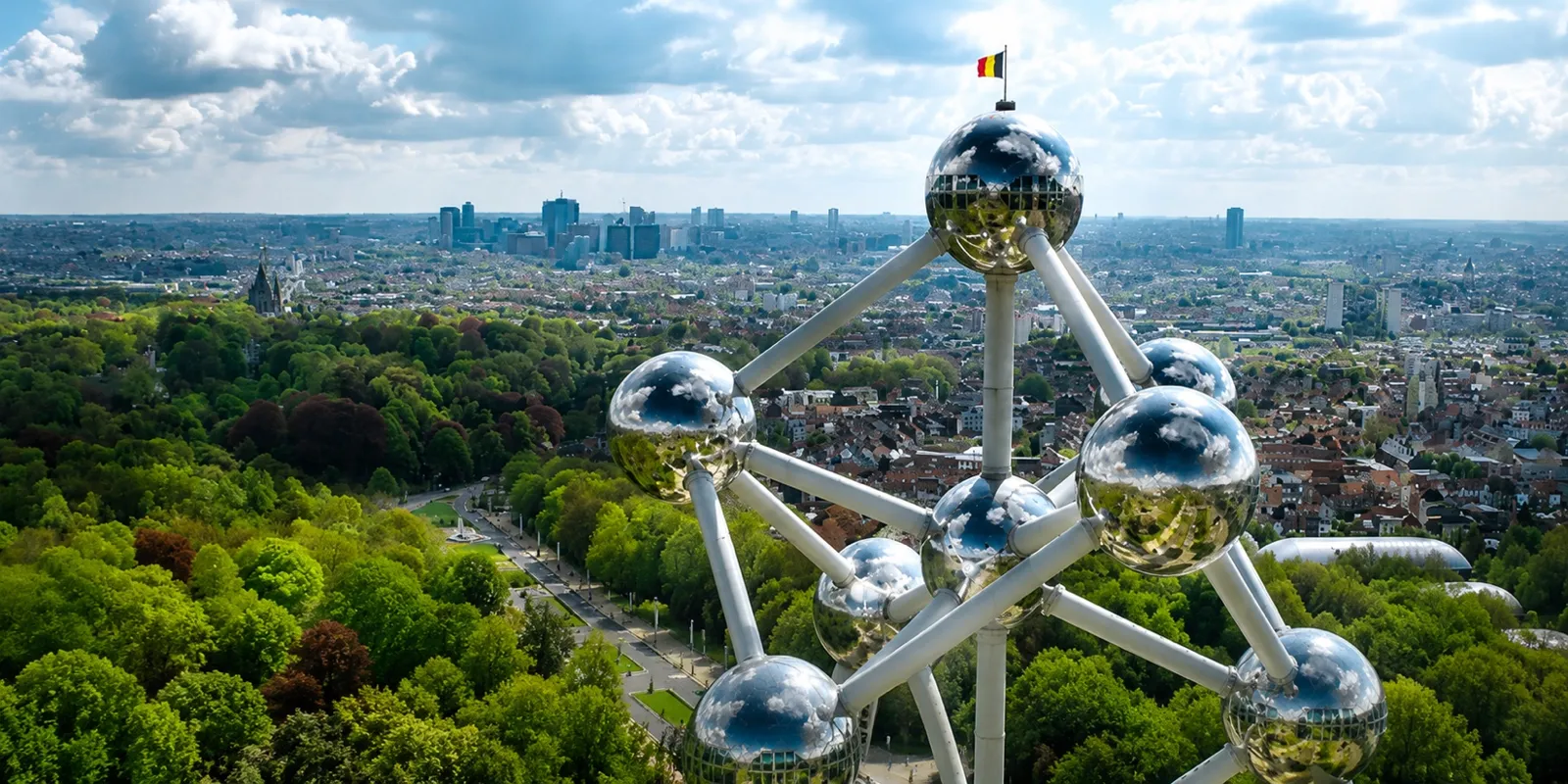
The Atomium was built for the 1958 World's Fair (Expo 58) and is now the symbol of modern Brussels. The structure is 102 metres high and represents an iron crystal magnified billions of times, with nine spheres connected by tubes. A lift takes you to the panoramic sphere at the top, while other spheres hold exhibitions. It is open every day from 10:00 to 18:00 (last entry 17:30); note the planned maintenance closure from 18 January to 5 February 2027.
Next door, Mini-Europe shows famous European monuments in miniature, a favourite with families. The Heysel area is about 15–20 minutes by metro or car from the centre, so it is easy to combine with a morning in the old town. More ideas for children are in our guide to Brussels with kids.
Museums, art and Belgian heritage
For a city of its size, Brussels has an exceptional number of museums. The essentials:
- Royal Museums of Fine Arts: Flemish masters in the Old Masters Museum and the world's largest collection of René Magritte in the Magritte Museum. (The Fin-de-Siècle Museum has been closed since January 2024.)
- Horta Museum in Saint-Gilles: the house and studio of Victor Horta, the father of Art Nouveau, part of a UNESCO World Heritage listing since 2000.
- Comics Art Museum: the home of Tintin, the Smurfs and Belgian comic strip art, in an Art Nouveau building by Horta.
- Musical Instruments Museum (MIM): a huge collection in the Old England building on the Mont des Arts.
- Natural Sciences Museum: its dinosaur gallery displays the famous Iguanodons of Bernissart, part of a group of around thirty skeletons found in a Belgian coal mine.
Good to know: on the first Wednesday of the month, several museums are free, mostly from 13:00, and the Brussels Card (24, 48 or 72 hours) gives access to many museums. Our full guide to the best museums in Brussels helps you choose.
The European Quarter
East of the centre, the European Quarter is home to the European Commission, the Council and the European Parliament. Two visits are free and well designed: the Parlamentarium, the Parliament's visitor centre, and the House of European History in the Leopold Park. Nearby, the Cinquantenaire Park and its triumphal arch hold several museums, and the Place Jourdan is home to Maison Antoine, one of the city's best-known friteries.
Sablon, Marolles, Saint-Gilles and Ixelles
To feel how people really live in Brussels, leave the centre for a few hours:
- Sablon: elegant squares, antique dealers, top chocolatiers and a weekend antiques market (Saturday 9:00–17:00, Sunday 9:00–15:00).
- Marolles: the historic working-class district below the Palace of Justice, with second-hand shops and the daily flea market on the Place du Jeu de Balle.
- Saint-Gilles: beautiful Art Nouveau streets, the Horta Museum and lively squares with cafés. Our guide to Brussels architecture and landmarks shows where to find the finest façades.
- Ixelles: the ponds, Place Flagey, the African-influenced Matongé area and plenty of restaurants.
We describe each area, and who it suits best, in our guide to the best neighbourhoods in Brussels.
Belgian food: chocolate, waffles, fries and beer
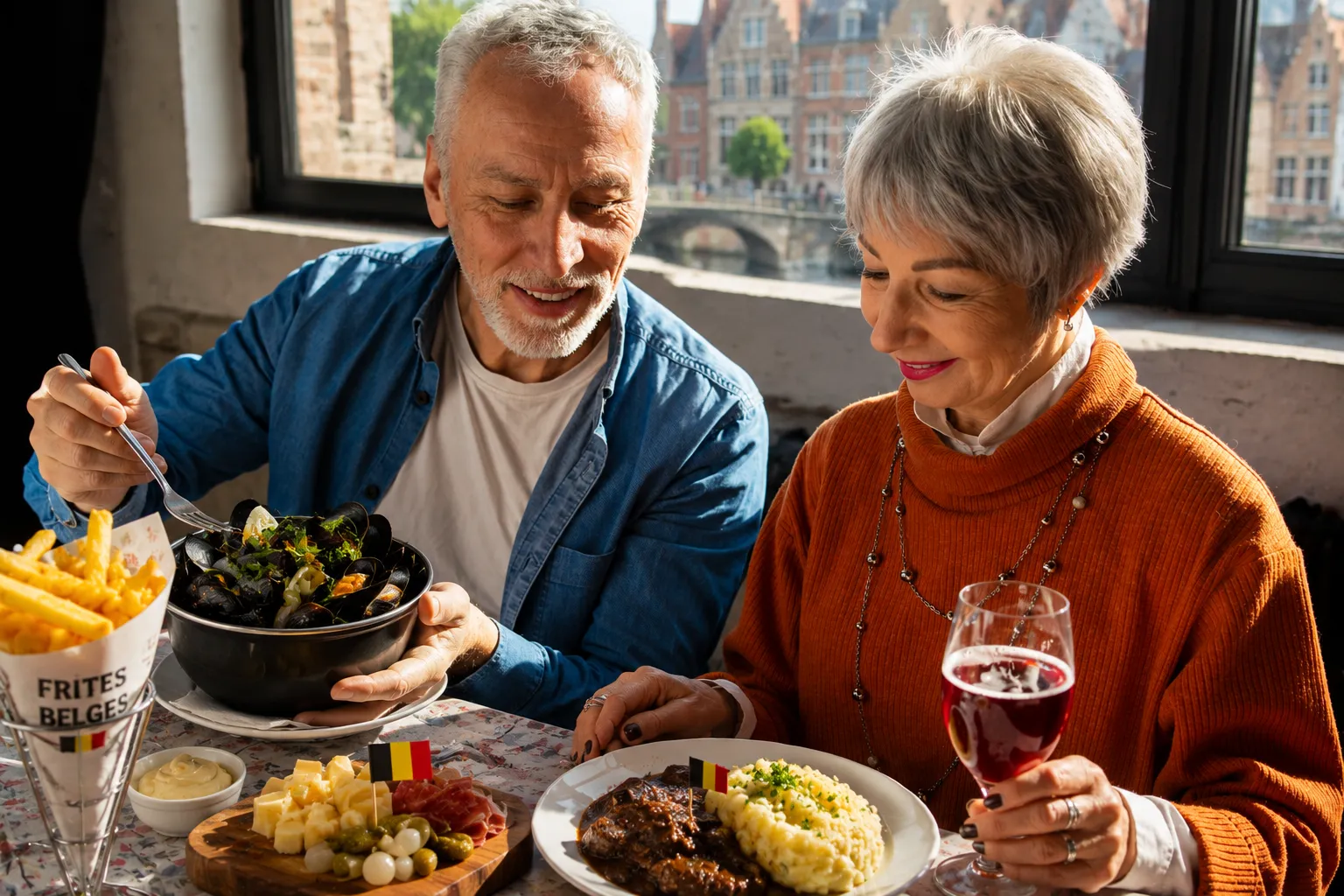
Eating well is one of the best reasons to visit Brussels. Start with the classics:
- Fries, cooked twice and served in a paper cone with a choice of sauces.
- Waffles: the light, rectangular Brussels waffle and the denser Liège waffle with caramelised sugar pearls.
- Chocolate: pralines from the historic houses around the Galleries and the Sablon.
- Moules-frites (mussels and fries) and carbonnade flamande, a beef and beer stew.
- Beer: Belgian beer culture is on UNESCO's list of intangible cultural heritage since 2016.
Where to eat each of them is in our Belgian food guide.
Shopping, markets and local experiences
- Chocolate shops in the Galleries and on the Sablon.
- Comic strip shops and the Comic Strip Route, a trail of murals painted on façades across the centre.
- Markets: the Jeu de Balle flea market every morning (until 14:00, 15:00 at weekends) and the large Midi market on Sunday mornings near Brussels-Midi station.
- Avenue Louise for international fashion brands, and the Rue Antoine Dansaert for Belgian designers.
Things to do in Brussels with children
Brussels works very well with kids: the Atomium and Mini-Europe, the dinosaurs at the Natural Sciences Museum, the Comics Art Museum, and green spaces such as the Brussels Park and the Cinquantenaire. Waffles and fries help too. See our full guide to Brussels with kids.
Getting around Brussels
- On foot: the historic centre is compact. Grand-Place, Manneken Pis, the Galleries, the Mont des Arts and the Sablon are all within about 15 minutes' walk of each other, although some streets are steep.
- Public transport: the STIB network combines metro, tram and bus. You can pay by tapping a contactless bank card or phone; a single journey cost €2.40 as of February 2026.
- By car: the whole Brussels region is a Low Emission Zone, which also applies to foreign vehicles. Parking in the centre is limited and expensive.
- Private chauffeur: the easiest way to combine sights that are far apart, such as the old town and the Atomium, or to add a day trip.
More details on airports, stations, tickets and safety are in our Brussels travel tips.
Brussels itineraries: one, two or three days
One day in Brussels
- Morning: Grand-Place, the Town Hall façades and the Royal Saint-Hubert Galleries.
- Late morning: Manneken Pis, then a waffle on the way to the Mont des Arts viewpoint.
- Lunch: moules-frites or a Belgian stew.
- Afternoon: the Royal Quarter and the Sablon, with a stop in a chocolate shop. Add the Magritte Museum if you like art.
- Evening: return to the Grand-Place to see it lit up.
Two days in Brussels
- Day 1: the one-day itinerary above.
- Day 2: the Atomium in the morning, then the European Quarter (Parlamentarium or House of European History), the Cinquantenaire Park and fries on the Place Jourdan. End in Ixelles or Saint-Gilles for dinner.
Three days in Brussels
- Days 1–2: as above.
- Day 3: either stay in the city for Art Nouveau in Saint-Gilles (book the Horta Museum), the Marolles flea market and the Comics Art Museum, or take a day trip to Bruges and Ghent. Our guide to the best day trips from Brussels compares the options.
Weather and the best time to visit
Brussels has a mild, changeable climate. Official averages for 1991–2020 give about 3.7 °C in January, the coldest month, and 18.7 °C in July, the warmest, with rain or snow on around 190 days a year. In practice, bring a light rain jacket in every season.
- Spring (April–May): blossoming parks and comfortable temperatures for walking.
- Summer (June–August): the longest days, outdoor terraces, the Ommegang pageant on the Grand-Place in early July and the Royal Palace opening.
- Autumn (September–October): fewer crowds and good museum weather.
- Winter (December): the Winter Wonders Christmas market and light show. Read our Brussels Christmas Market 2026 guide.
Accessibility and practical considerations
- Cobblestones and slopes: the old town has uneven paving and the walk up to the Royal Quarter is steep. Plan rest stops, or use a car for the uphill part.
- Metro: most metro stations (more than three-quarters) have lifts, with work underway to equip the rest.
- Atomium: a lift reaches the panoramic sphere, but the exhibition spheres are reached by steep escalators and stairs, so wheelchair users can visit the panorama only.
- Safety: Brussels is generally safe for visitors, but keep an eye on bags in crowded places and around the big stations, as in any capital.
See Brussels with a private guide
If you only have a few hours, or you want the stories behind the façades, a private tour is the most comfortable way to see Brussels. Our tour The Heart of Belgium — History, Elegance & Chocolate covers the Grand-Place, the Galleries, Manneken Pis, the Royal Quarter and the Mont des Arts in about four hours, with a certified guide and a chauffeur in a luxury Mercedes. It is 100% private, for up to 6 guests, and adapts to your interests.
Staying longer? Combine Brussels with a private day trip to Ghent and Bruges, Antwerp or Waterloo, or ask us to design a tailor-made tour.