
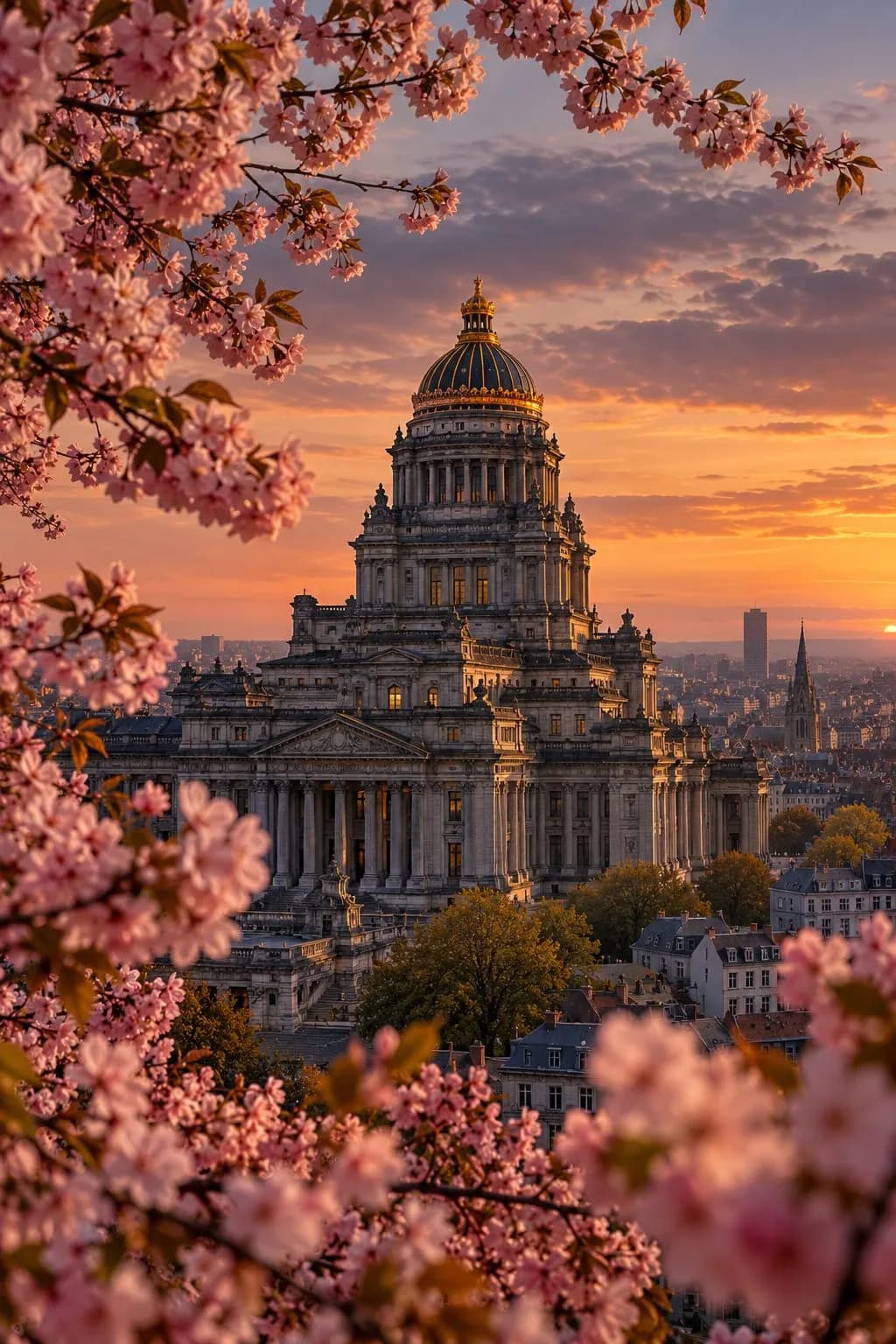
Brussels is an open-air museum of European architecture. Within a few kilometres you can trace six centuries of styles: the Gothic Town Hall, the Baroque guildhouses of the Grand-Place, the grand neoclassical Royal Quarter, the curving lines of Art Nouveau, the geometry of Art Deco and the futuristic Atomium. Four sites in the city are listed by UNESCO.
This guide is part of our complete Brussels travel guide.
Brussels' UNESCO World Heritage Sites
- The Grand-Place, listed in 1998.
- The major town houses of Victor Horta: the Tassel, Solvay and van Eetvelde houses and Horta's own house (now the Horta Museum), listed in 2000.
- The Stoclet Palace by Josef Hoffmann, listed in 2009.
- The Sonian Forest, on the south-eastern edge of the region, part of the transnational listing of ancient European beech forests.
Gothic Brussels
The Town Hall
The Town Hall on the Grand-Place was built in the 15th century and is one of the finest examples of Brabantine Gothic architecture. Its slender spire, about 96 metres high, is topped by a statue of Saint Michael, the patron saint of Brussels.
The Cathedral of St Michael and St Gudula
On a hill between the old town and the upper city, the cathedral took about three centuries to build, which explains its mix of styles. Its twin towers and white stone façade are impressive, and entry to the cathedral is free (the treasury and the crypt have a small fee; the crypt can only be visited by appointment).
Notre-Dame du Sablon
On the Sablon square, this church is a jewel of late Gothic architecture, famous for its tall stained-glass windows, which glow beautifully when the interior is lit.
The Grand-Place guildhouses
Around the Town Hall, the guildhouses of the Grand-Place were rebuilt in stone after the French bombardment of 1695, in a rich Baroque style decorated with gilding, statues and symbols of each trade. The ensemble, with the Gothic Town Hall and the neo-Gothic King's House, makes the square one of the most beautiful in Europe.
The Royal Quarter and neoclassical Brussels
In the 18th and 19th centuries, the upper city was redesigned in a grand neoclassical style: the Place Royale, the Brussels Park and the Royal Palace face each other along symmetrical avenues. The 19th century also brought the Royal Saint-Hubert Galleries (1847), an elegant glass-covered arcade by Jean-Pierre Cluysenaar.
The Palace of Justice
Built in the late 19th century on the edge of the Marolles, the Palace of Justice is one of the largest buildings constructed in that century, crowned by a huge dome. After decades under scaffolding, the central part of its main façade on the Place Poelaert was freed in June 2026, although restoration continues on the rest of the building until about 2035. The square in front offers a wide view over the city.
The Cinquantenaire
Built to celebrate the 50th anniversary of Belgian independence, the Cinquantenaire complex and its monumental triumphal arch now house several museums, in a large park east of the centre.
Art Nouveau: Brussels' golden age
At the end of the 19th century, Brussels became the birthplace of Art Nouveau architecture. Architects such as Victor Horta and Paul Hankar designed houses with curving iron, mosaics, stained glass and decorative façades inspired by nature.
Where to see Art Nouveau
- Horta Museum (Saint-Gilles): Horta's own house and studio, the best place to step inside an Art Nouveau interior. Book in advance.
- Old England (Mont des Arts): a former department store by Paul Saintenoy (1899), now the Musical Instruments Museum.
- Comics Art Museum: a former textile warehouse designed by Horta.
- Saint-Gilles and Ixelles: streets of Art Nouveau houses, best explored on foot or with a guide.
- Square Ambiorix and Square Marie-Louise area, near the European Quarter, which includes several remarkable façades.
Art Deco and modern Brussels
- Stoclet Palace (Avenue de Tervueren): a masterpiece of the Vienna Secession by Josef Hoffmann, listed by UNESCO. Admire the exterior from the street.
- Basilica of the Sacred Heart in Koekelberg: one of the largest churches in the world and often described as one of the largest Art Deco buildings, with a panoramic terrace.
- Flagey (Ixelles): a former broadcasting building with a ship-like Art Deco silhouette, now a cultural centre.
- The Atomium (1958): 102 metres high, nine spheres, built for the World's Fair and today the symbol of modern Brussels.
A two-hour architecture walk
- Start at the Grand-Place: Town Hall, guildhouses and King's House.
- Walk through the Royal Saint-Hubert Galleries.
- Climb to the Cathedral of St Michael and St Gudula.
- Continue to the Mont des Arts and the Old England building.
- Cross the Place Royale to the Sablon and Notre-Dame du Sablon.
- Finish at the Palace of Justice for the view over the city.
For Art Nouveau, plan a separate half-day in Saint-Gilles and Ixelles, described in our guide to the best neighbourhoods in Brussels.
Discover Brussels' architecture with a private guide
A good guide brings the façades to life: the symbols hidden on the guildhouses, the stories of the royal family and the secrets of Art Nouveau. Our private tour The Heart of Belgium — History, Elegance & Chocolate covers the Grand-Place, the Galleries, the Royal Quarter and the Mont des Arts, and can include Art Nouveau architecture on request, with a chauffeur to save your legs on the steep streets.
Also read: the best museums in Brussels.