
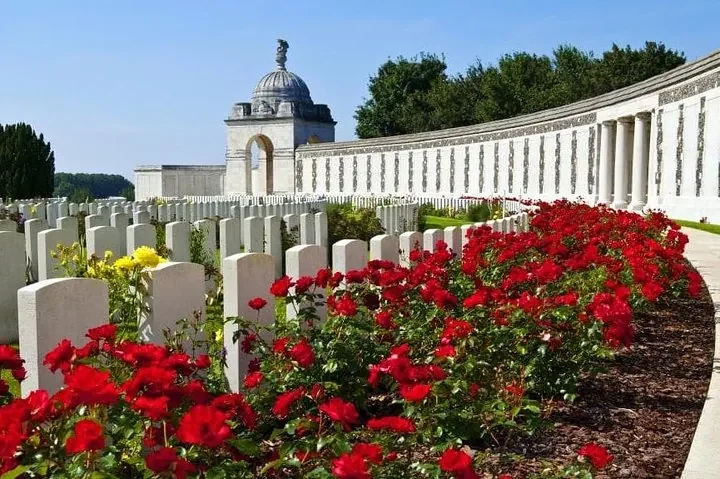
For four years, from 1914 to 1918, the countryside around the Belgian town of Ypres (Ieper in Dutch) was one of the deadliest battlefields of the First World War. Today, the gentle fields of West Flanders are dotted with war cemeteries, memorials and museums that tell the story of the hundreds of thousands of soldiers who fought and died here.
Ypres is about 125 km west of Brussels, so Flanders Fields makes a powerful and moving day trip. Here is what to see, how to get there, and how to experience the famous Last Post ceremony at the Menin Gate.
Why Flanders Fields matters
After German troops passed through briefly in October 1914, Ypres stayed in Allied hands for the rest of the war, and the Allied front line around it, known as the Ypres Salient, was fought over for the entire war. The town was almost completely destroyed and rebuilt after 1918. Some of the most famous episodes of the war happened here: the first large-scale poison gas attack in April 1915, and the Battle of Passchendaele in 1917, remembered for its mud and its terrible losses.
The name "Flanders Fields" comes from the poem In Flanders Fields, written in May 1915 by the Canadian doctor John McCrae near Ypres. It made the red poppy the symbol of remembrance around the world.
What to see on a Flanders Fields day trip
The Menin Gate and the Last Post
The Menin Gate Memorial, on the eastern edge of Ypres, carries the names of more than 54,000 soldiers of the British Empire who died in the Salient and have no known grave. Every evening at 8 pm, buglers of the local fire brigade sound the Last Post under the arch, as they have done since 1928, except during the German occupation in the Second World War. Traffic is stopped, the crowd falls silent, and wreaths are often laid. The ceremony is free and needs no reservation. It is one of the most moving moments you can experience in Belgium.
The In Flanders Fields Museum
Housed in the rebuilt Cloth Hall on the Market Square, the In Flanders Fields Museum tells the story of the war in West Flanders through the personal stories of soldiers, nurses and civilians. It is the best place to start your visit and understand what you will see in the landscape. Check the museum website for current opening hours.
Tyne Cot Cemetery
In Zonnebeke, near the village of Passendale, Tyne Cot is the largest Commonwealth war cemetery in the world, with nearly 12,000 graves. Its Memorial to the Missing lists about 35,000 more names of soldiers whose bodies were never found. The scale of it, row after row of white headstones on a gentle slope near Passchendaele, stays with every visitor. Entry is free, and there is a small visitor centre.
The Memorial Museum Passchendaele 1917
Also in Zonnebeke, this museum is known for its reconstructed underground dugouts and trenches, which show how soldiers lived on the front line.
Essex Farm Cemetery
Just north of Ypres, beside the bunkers of an advanced dressing station, this cemetery is where John McCrae is believed to have written In Flanders Fields.
Langemark German Military Cemetery
A very different atmosphere: dark stones, oak trees and a mass grave. More than 44,000 German soldiers are buried here, a reminder that the war's losses were felt on every side.
Armistice Day in Ypres: 11 November 2026
Every year on 11 November, the anniversary of the end of the First World War, Ypres holds a full day of remembrance. In 2026, Armistice Day falls on a Wednesday. The programme usually includes:
- Morning: remembrance services, including a mass in St Martin's Cathedral, and the Poppy Parade through the town
- 11:00: the official ceremony and Last Post at the Menin Gate. Access is by invitation or members' ticket only, but it is broadcast on a big screen on the Market Square
- Afternoon: a carillon concert and a guided walk
- 20:00: the daily Last Post ceremony under the Menin Gate
Expect several thousand visitors. In previous years the town centre has been closed to traffic and parking from 8 am, so plan to use the car parks on the edge of town and walk in. Check the official programme of the City of Ypres before you go, as details change from year to year.
How to get to Flanders Fields from Brussels
- By car: about 1 hour 30 minutes to 1 hour 45 minutes to Ypres. A car is by far the easiest way to visit the cemeteries and memorials, which are spread across the countryside.
- By train: about 2 hours to Ypres, usually with a change. From the station you can walk to the town centre and the Menin Gate, but the sites outside town are hard to reach without a car.
- By private tour: pickup at your Brussels hotel, a private certified guide who brings the history to life at each site, and a professional chauffeur who drives you between them. You can also choose to stay for the 8 pm Last Post.
Tips for your visit
- Arrive early for the Last Post. In summer, at weekends and around 11 November, the crowd under the Menin Gate can be large. Be there by 7:15 pm for a good place, and even earlier around 11 November.
- Respect the moment. The Last Post is a ceremony of remembrance: stay silent during the ceremony and do not applaud.
- Looking for a relative? Search the Commonwealth War Graves Commission database before your trip. If you know where a family member is buried or remembered, a private tour can include that cemetery.
- Dress for the weather. Cemeteries are in open fields, so bring a warm coat and comfortable shoes in autumn and winter.
- Plan a full day. With the travel time from Brussels, a museum, two or three cemeteries and the Last Post, Flanders Fields is a long but unforgettable day.
Visit Flanders Fields with a private guide
The battlefields of the Ypres Salient are best understood with someone who knows the stories behind the names. On our private tour Flanders Fields: Where History Lives in the Landscape, a certified guide takes you through the In Flanders Fields Museum, Tyne Cot and the key sites of the Salient, while a professional chauffeur drives you in a comfortable luxury Mercedes, with hotel pickup and drop-off in Brussels. 100% private, up to 6 guests, at your own pace.
Planning more day trips? See our guide to the best day trips from Brussels, or visit another chapter of European history at Waterloo.